
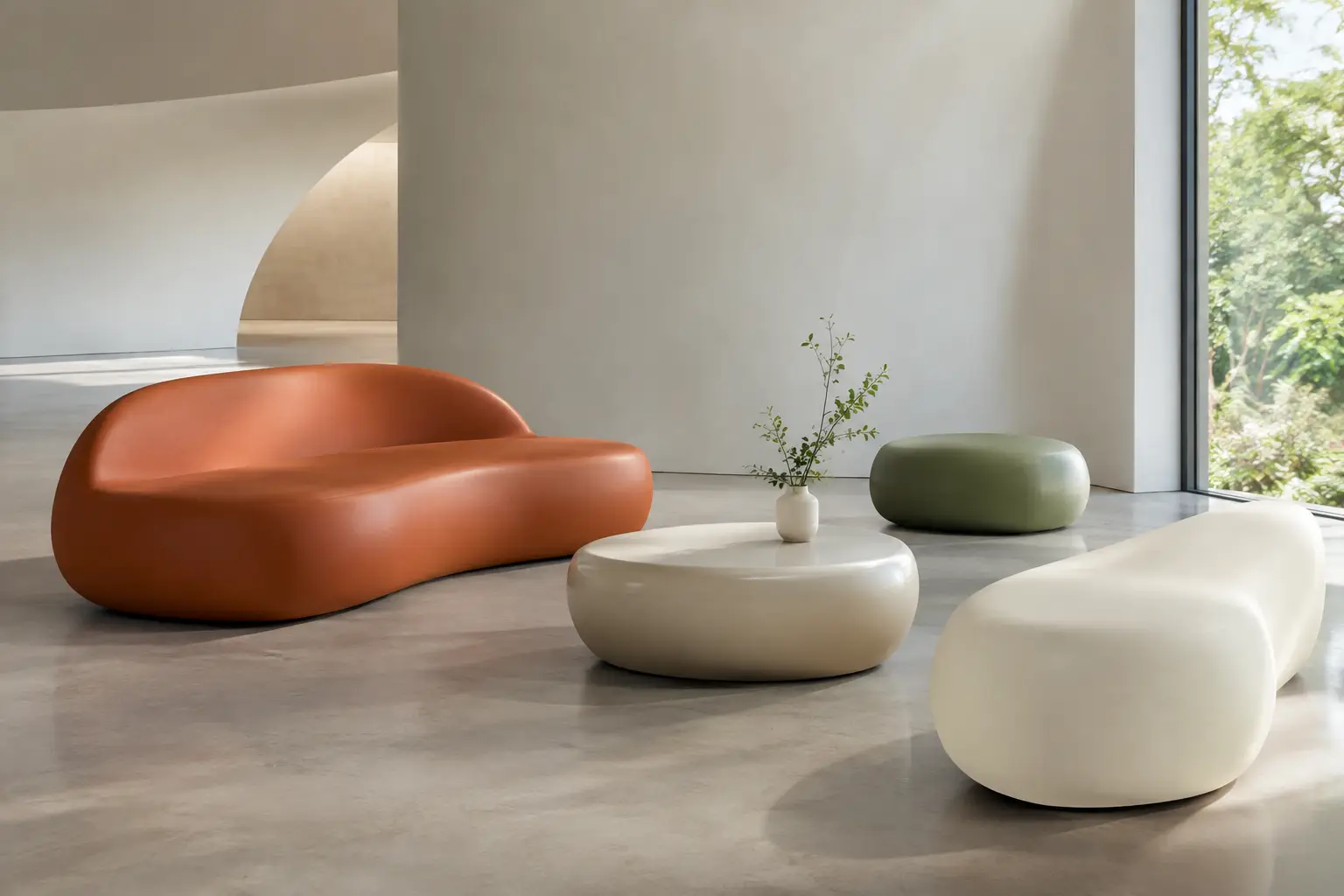
A perfectly rectangular lounge rarely becomes the image guests remember. A low seating island that curves around a lobby column, a pebble-like bench that directs circulation, or a generous sculptural pouf can. Organic shaped contract furniture gives designers a way to turn seating into part of the spatial concept rather than a necessary object placed after the architecture is complete.
For hospitality, workplace, retail, education, and public interiors, the appeal is obvious: softer forms invite people to pause, gather, and move through a space differently. But specifying expressive furniture for commercial use takes more than choosing an interesting silhouette. The form must support real use, the material must withstand it, and the fabrication process must translate a visual idea into a repeatable, maintainable contract-grade object.
Why organic forms change the experience of a space
Organic furniture does not need to mimic nature literally. The term can describe any form that feels fluid rather than rigid: asymmetrical curves, rounded volumes, continuous contours, soft geometric shapes, and seating elements that appear carved rather than assembled. These forms can bring visual relief to hard architectural surfaces such as stone, glass, concrete, metal, and tile.
Their strongest contribution is often behavioral. A straight bench suggests a row. A curved bench creates a social arc. A large, irregular seating landscape can establish informal zones without erecting partitions or adding visual clutter. In an open lobby, airport lounge, museum, or flexible workplace, that distinction matters. Furniture can define where people wait, meet, work, or rest while preserving the openness of the plan.
Organic shapes also make branded environments more memorable. A conventional sofa can disappear into a well-designed interior. A custom seating form with a distinctive profile, saturated color, or oversized scale becomes part of the project identity. This is particularly valuable in retail and hospitality, where the physical environment must carry as much character as the graphic system.
Organic shaped contract furniture needs more than a bold outline
The expressive value of a curved form is only one part of the specification. In contract environments, every sculptural decision has practical consequences. Deep concave areas can collect debris. Extremely low profiles may look dramatic but can be difficult for some users to rise from. Narrow points and sharp transitions may compromise usable seating area, even when the overall footprint is large.
The best projects resolve those issues early. Designers should consider how a person approaches the piece, where they naturally sit, whether bags or coats will be placed on it, and how facilities teams will clean around it. A form can remain visually unexpected while offering clear, comfortable points of contact.
Scale is equally important. Small organic pieces can read like accessories in a vast atrium. Conversely, an oversized seating landscape can overwhelm a compact boutique or reception area. Mockups, scaled drawings, and material samples help determine whether the gesture has the right presence before production begins.
Comfort should follow the geometry
Curves do not automatically equal comfort. Seat height, depth, pitch, and edge radius still determine whether a piece supports a brief pause or an extended stay. A generous rounded edge may be ideal for a casual waiting area, while a more defined seat zone may be needed in a lounge intended for work or dining.
This is where custom fabrication creates an advantage. Instead of forcing a design concept into standard sofa modules, the internal geometry can be developed around the intended use. A single sculptural volume can include upright perching positions, relaxed lounge areas, and transitional surfaces, provided the human factors are considered from the beginning.
Durability must be designed into the finish
Contract furniture is judged long after installation day. It encounters luggage wheels, coffee spills, frequent cleaning, children, pets, moving equipment, and constant contact. Upholstery can be appropriate for many projects, but it introduces seams, tension points, and maintenance needs that may conflict with a highly continuous form.
Coated foam offers a different route for certain applications. Its finish can wrap a complex volume in a continuous, tactile skin, allowing rounded forms and integrated details that would be difficult to achieve with conventional upholstery. The result can feel monolithic while remaining soft to the touch and visually precise.
Finish selection still depends on the setting. A quiet executive lounge has different acoustic, tactile, and aesthetic priorities than a high-turnover food hall or a covered exterior terrace. Color, texture, gloss level, cleaning protocols, UV exposure, and expected traffic should all be part of the material conversation. There is no universal best finish, only the right finish for the project conditions.
Specifying sculptural furniture with confidence
A clear brief turns an ambitious object into a manufacturable one. Early discussions should define the project’s intended visual effect, but they should also identify dimensions, capacity, installation constraints, cleaning expectations, fire requirements, and delivery access. A beautifully formed object that cannot pass through a doorway, elevator, or loading route becomes an expensive problem.
For larger installations, sectional construction may be necessary. Done well, segmentation does not dilute the visual impact. Joint lines can be positioned along natural changes in geometry, concealed at low-visibility points, or incorporated into the design rhythm. The goal is to retain the reading of a single continuous form while making transport, placement, and future service realistic.
Color deserves similar rigor. Neutral organic seating can make a refined architectural setting feel calm and grounded. Intense colors can turn the same forms into wayfinding tools, brand statements, or focal points. Because curved volumes catch light differently across their surface, color samples should be evaluated under the project’s actual lighting whenever possible. A shade that appears understated on a small chip can become commanding on a six-foot sculptural bench.
Where these forms work hardest
In hospitality, organic seating can soften the first moments of arrival and create an immediate sense of place. A lobby needs furniture that photographs well, welcomes varied groups, and supports circulation throughout the day. Curved islands and sculptural lounge pieces can meet all three demands when their access points are thoughtfully planned.
In retail, they can create a pause within a high-energy customer journey. A bench shaped as part of the brand environment is not merely somewhere to sit. It can frame a product zone, slow circulation near a feature display, or give accompanying guests a comfortable place to wait without breaking the visual language of the store.
Public and workplace environments benefit from their zoning power. A cluster of soft, rounded elements can create a destination inside a large open room. The pieces can establish informal meeting points, distribute people away from congested areas, and introduce comfort without relying on rows of interchangeable furniture.
Outdoor and semi-outdoor projects require an additional layer of discipline. Drainage, solar exposure, surface temperature, anchoring, and seasonal maintenance all affect performance. The silhouette may be playful, but the detailing cannot be casual. Specifying a form designed for its actual exposure conditions is essential.
From concept sketch to production-ready object
The most successful custom pieces begin with a strong design intention and allow fabrication expertise to sharpen it. A hand sketch, rendering, or reference image can establish the visual direction, but it is only the starting point. The next stage is translating that idea into dimensions, radii, structural logic, foam behavior, coating requirements, and production tolerances.
This collaboration is where the original idea either becomes stronger or gets compromised. An experienced manufacturer should challenge details that create weak points, unnecessary complexity, or poor usability while protecting the concept that made the piece worth pursuing. Sixinch approaches coated foam fabrication as both a material discipline and a design tool, helping architects and designers move from expressive geometry to objects built for real commercial environments.
The right organic form does not simply fill an empty floor area. It gives a space a recognizable gesture, tells people where to gather, and makes comfort part of the architecture. Start with the behavior you want to invite, then give that behavior a shape people will remember.