
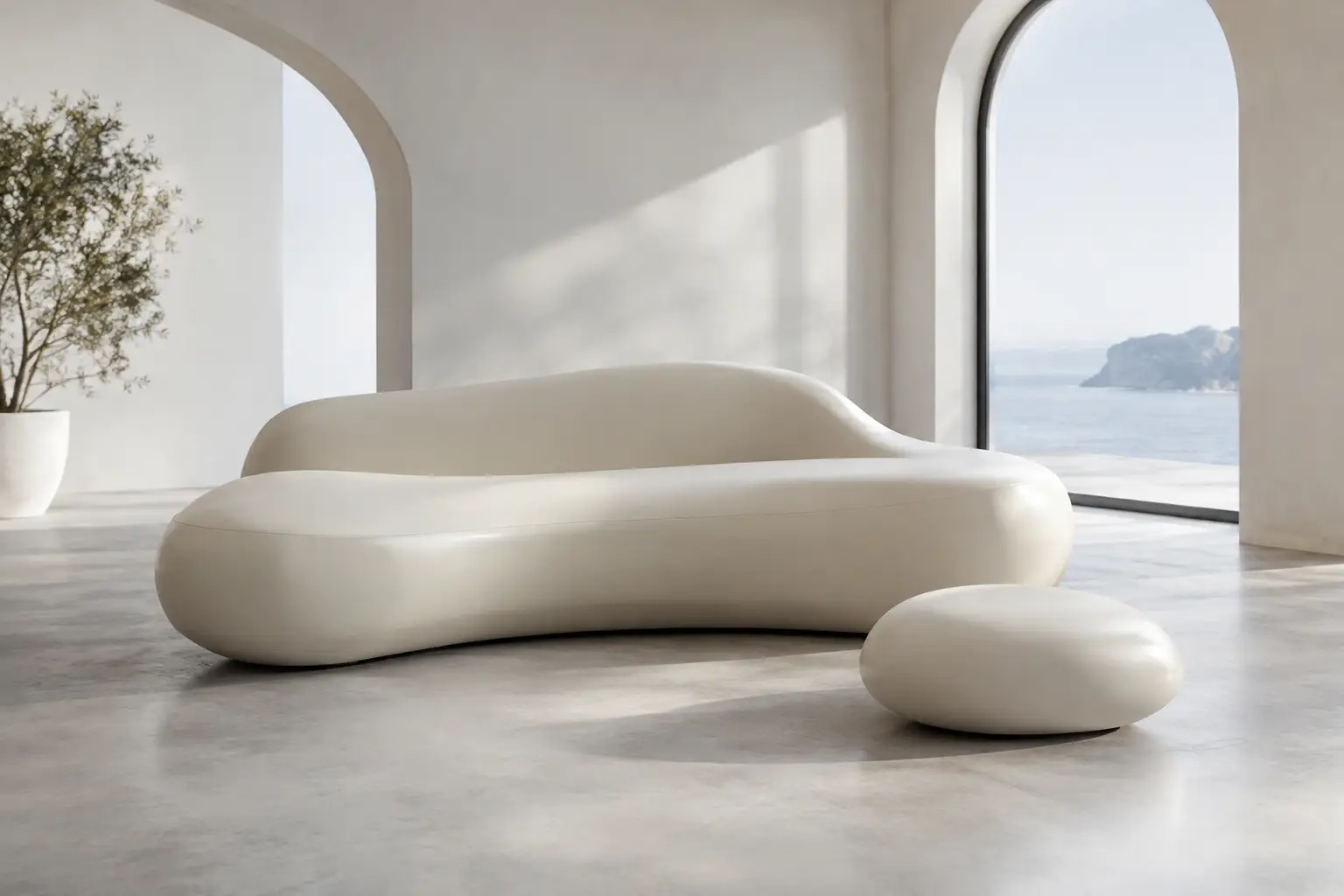
A sofa can define the entire reading of a room before anyone sits on it. In a hotel lobby, gallery, flagship store, or workplace lounge, it may function as a landmark, a circulation cue, a social platform, and a branded gesture at once. Designing sculptural sofas means treating seating as an architectural object while preserving the physical comfort and long-term performance people expect from furniture.
That balance is where ambitious concepts either become memorable spaces or difficult installations. A dramatic silhouette alone is not enough. The strongest sculptural sofas are conceived around how people approach them, occupy them, move around them, and experience them over years of public use.
Start With the Spatial Role, Not the Silhouette
A sculptural sofa should answer a spatial question. Does the project need to gather guests around a central feature? Soften a hard architectural grid? Create privacy within an open lounge? Lead visitors through a retail environment? These decisions shape the form before styling begins.
A long, low serpentine sofa can guide movement through a broad atrium while offering multiple informal seating zones. A high-backed, enveloping form can create a quieter pocket within an active hospitality setting. A radial composition can turn an empty central floor area into a destination. Each approach produces a distinct visual effect, but more importantly, each changes how a space works.
This is why plan-view design matters as much as elevation. A sofa may look compelling in a rendering yet obstruct a principal path, create unusable gaps near walls, or leave the seated user exposed to busy traffic. Early floor plans should test circulation, access, sightlines, and clearances alongside the desired visual gesture.
Designing Sculptural Sofas Around the Body
The word sculptural can suggest visual freedom, but seating still has a human scale. The more unconventional the geometry, the more deliberately the designer must establish where the body rests, how it rises, and whether a seated guest feels supported rather than perched.
Seat height, seat depth, back angle, and edge softness should be resolved early. Curved seating requires particular attention because the user rarely sits in the same orientation as on a straight sofa. A generous inner curve may invite conversation, while a tight radius can force awkward posture or limit the usable number of seats. Likewise, a dramatically sloped shell can appear fluid and generous but needs a defined sitting zone to prevent the body from sliding forward.
Comfort also depends on intended dwell time. A reception lounge may prioritize short, flexible use, allowing a more upright posture and visually assertive proportions. A hospitality lounge, executive waiting area, or premium retail salon may require deeper seating and more pronounced support. There is no universal comfort profile. The right solution depends on the setting, expected occupancy, and the behavior the space is designed to encourage.
Tactile cues matter as well. A continuous foam-coated form can visually erase the usual divisions between arm, back, base, and seat. That purity is powerful, yet subtle changes in contour can still tell users where to sit. A softened recess, a rising edge, or a slight back transition can guide the body without interrupting the design language.
Choose a Material System That Can Hold the Idea
Many sculptural forms fail in production because the selected construction method was never suited to the geometry. Conventional upholstered furniture is often built around frames, panels, seams, and standard cushioning. That construction can be ideal for many applications, but it may impose visible breaks or structural limitations that conflict with a continuous, monolithic concept.
Coated foam fabrication offers a different design vocabulary. It allows complex volumes to be shaped with smooth transitions, rounded edges, deep curves, and integrated backrests that would be difficult to achieve through conventional upholstery. The coating creates a durable, tactile skin over the foam core, giving the object a unified appearance without relying on stitched upholstery lines.
The finish should be selected for the project rather than treated as an afterthought. A matte surface can reinforce an architectural, mineral-like presence. A softer-touch finish can make a large volume feel more inviting. Color can either make the sofa a visual anchor or allow its silhouette to work quietly within a layered interior. In commercial environments, the material system must also respond to maintenance expectations, traffic levels, cleaning protocols, and exposure to sunlight or outdoor conditions where applicable.
For custom work, material choice and form development should happen together. A narrow projecting element, an extremely thin edge, or a heavily cantilevered volume may require adjustment to preserve structural stability and finish quality. These are not compromises in creativity. They are the decisions that turn a compelling sketch into an object that can be specified with confidence.
Use Scale to Create Impact Without Overwhelming the Room
Sculptural sofas are frequently designed as hero pieces, which makes scale especially important. A form that feels generous in a large open lobby can dominate a smaller lounge, while a too-small object can lose its intended presence when surrounded by high ceilings and expansive finishes.
Mockups, taped floor outlines, and scaled models help reveal proportion before production begins. Designers should assess not only the sofa’s overall footprint but also its visual mass. High backs, saturated colors, broad curves, and uninterrupted surfaces can make a piece read larger than its measured dimensions. Conversely, elevated bases, open centers, or segmented configurations can reduce visual weight while maintaining a strong silhouette.
Consider the sofa from every arrival point. The frontal view may be striking, but side and rear elevations are equally significant in open-plan spaces. A sculptural sofa often sits away from walls, meaning its backside becomes part of the interior composition. The rear should feel intentional, not like a leftover service surface.
Design for Specification, Installation, and Daily Use
A bold concept earns its place in a project when it remains practical after the opening day. Before finalizing the design, resolve the realities that influence delivery and performance: access routes, elevator dimensions, site assembly, floor loading, anchoring requirements, cleaning access, and the relationship to power or integrated tables.
Modularity can be valuable for large-scale sofas, especially where access is constrained or future reconfiguration is possible. Yet visible joints should support the composition rather than interrupt it. A modular system can follow a continuous curve, repeat a geometric rhythm, or allow contrasting colors to mark separate seating territories.
Public and hospitality applications also benefit from clear performance criteria. Specify the expected use intensity, whether the sofa will be freestanding or fixed, and how the surface will be maintained. When a design includes integrated planters, lighting, tables, or charging elements, coordinate these systems early. Retrofitting them later often disrupts the purity of the form.
Sixinch approaches this stage as fabrication development, not simply manufacturing. The objective is to retain the force of the original concept while refining its proportions, internal logic, surface treatment, and installation strategy for the conditions of the actual project.
Let Color and Composition Carry the Brand Experience
A sculptural sofa can become an effective part of environmental branding without turning into signage. A distinctive color field can establish recognition at the entry of a workplace, retail space, or cultural venue. A custom contour can echo a logo, landscape feature, or architectural motif in a more sophisticated and inhabitable way.
Restraint is often what gives the gesture authority. If the sofa has an expressive silhouette, a single confident color may be more powerful than a complex palette. If the broader interior is deliberately quiet, a rich tonal composition can add depth without competing with artwork, merchandise, or wayfinding.
The best projects do not ask sculptural seating to behave like decoration. They allow it to organize space, invite use, and hold attention through a form that has been engineered as carefully as it has been imagined. Start with the experience you want people to have when they encounter the piece, then give that experience a shape worthy of the room.