
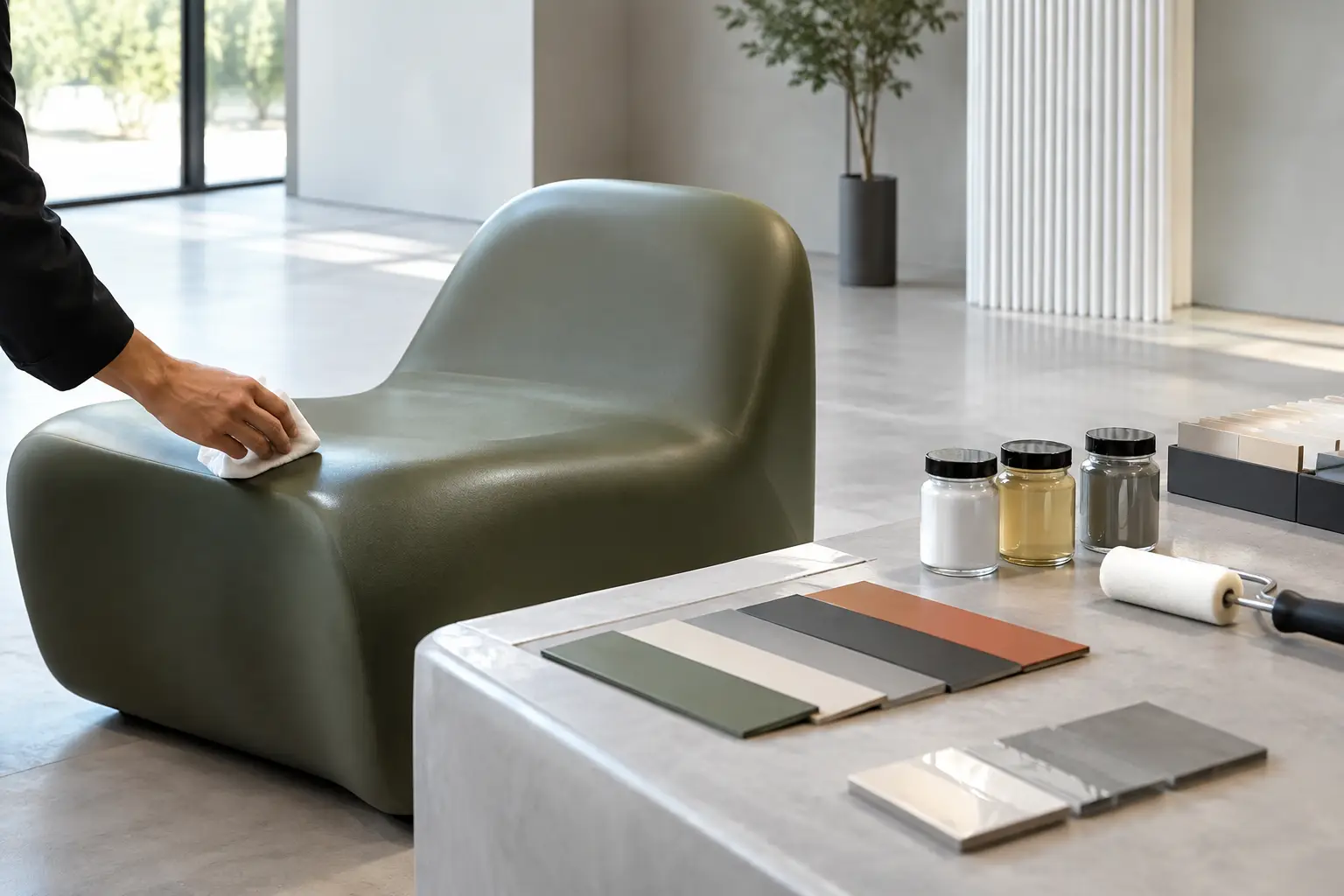
A finish can make a sculptural bench feel like a gallery object, or make it look tired after one busy season in a hotel lobby. Knowing how to evaluate furniture coatings is therefore not a final-box exercise on a specification sheet. It is a design decision that affects form, tactile character, maintenance, safety, and the long-term impression of the entire space.
For architects and designers working with distinctive seating, public-space furniture, and custom forms, the right question is not simply, “Which coating is most durable?” The better question is: durable against what, in which environment, and without compromising the intended visual and physical experience?
Start With the Environment, Not the Swatch
A small color chip cannot explain how a coating will perform on a curved lounge seat, a planter beside a pool, or a playful seating landscape in a high-traffic public interior. Begin with the project conditions before reviewing colors, textures, or gloss levels.
Consider who will use the object and how. A low bench in a retail environment may be exposed to bags, shoes, and frequent repositioning. A hospitality lounge piece must withstand repeated contact, beverage spills, sunscreen, and aggressive cleaning. Exterior furniture faces a different set of pressures: UV exposure, standing water, temperature shifts, pollution, and the expansion and contraction that comes with changing weather.
The location also changes the visual requirement. A satin surface may suit a refined indoor lounge where light moves softly across the furniture. A more textured or matte finish can help conceal incidental marks in active public areas. Neither choice is automatically better. The right finish is the one that supports the use case while preserving the design intent.
How to Evaluate Furniture Coatings at the Material Level
A coating is a system, not just a skin. Its performance depends on the chemistry of the finish, the substrate beneath it, the preparation of that substrate, the application process, and the curing conditions. This matters especially for furniture with complex geometry, where a finish must remain consistent across tight radii, broad planes, edges, and integrated details.
Ask what the coating is designed to do. Some finishes prioritize a soft-touch feel, while others are selected for abrasion resistance, water resistance, UV stability, or easy cleaning. A coating engineered for a protected interior may not be the right choice for an outdoor terrace, even if its appearance is initially identical.
Adhesion deserves close attention. A coating that does not bond correctly to its substrate can crack, peel, or delaminate over time. With coated foam furniture, the relationship between a flexible foam core and the exterior coating is particularly significant. The finish needs to accommodate the object’s geometry and intended use without turning a soft, expressive form into a brittle surface.
For custom pieces, ask how the manufacturer manages transitions. Areas around seams, corners, underside edges, and attachments often reveal the difference between a merely attractive sample and a well-engineered object. Coating expertise is visible in the places most people do not see first.
Match the Finish to the Geometry
Furniture coatings change the way a shape is read. A glossy finish amplifies highlights and makes curves appear more dramatic, but it can also reveal surface irregularities and fingerprints more readily. Matte surfaces absorb light and can feel quieter, though very matte finishes may show scuffs or require more specific cleaning protocols.
Texture is equally important. A fine texture can add grip, visual depth, and a more forgiving surface for high-contact applications. A smoother coating creates a sharper, more graphic result and is often easier to wipe clean. The trade-off is that a smooth, highly uniform surface places greater demands on fabrication quality, especially across large sculptural forms.
Do not evaluate a coating only on a flat panel. Request a sample that includes the kinds of curves, edges, and transitions found in the design. If the project involves an oversized custom seat or an integrated architectural element, a partial mockup is often worth the time. It clarifies how light behaves across the form and whether the selected texture supports the original concept.
Test Durability Against Real Use
“Durable” is too vague to be useful without a defined performance target. A finish can resist abrasion yet remain vulnerable to certain chemicals. It can tolerate water but fade under prolonged UV exposure. It can be easy to clean while still being susceptible to sharp impacts.
Specify the risks that are real for the project. In a restaurant, prioritize stain resistance and compatibility with the cleaning agents used by the operations team. In a workplace or education setting, abrasion, scuffing, and repeated cleaning may be more critical. For exterior installations, evaluate UV stability, moisture resistance, and expected performance across seasonal temperature changes.
Ask for relevant test information, but read it in context. Standardized testing provides useful comparisons between materials, not a guarantee that every application will perform identically. The object’s shape, placement, frequency of use, and maintenance routine all influence its service life.
Cleaning Is Part of Performance
A coating should be specified alongside a cleaning plan. If facilities teams need specialized products, lengthy procedures, or delicate handling for a heavily used public piece, the finish may not be appropriate for the application.
Clarify which cleaning agents are approved, how quickly spills should be removed, and whether disinfectants can be used without dulling or damaging the surface. This is especially relevant in hospitality, healthcare-adjacent environments, retail, and shared workplaces. A coating that looks immaculate on opening day but cannot be maintained realistically will not support the project over time.
Assess Color, Consistency, and Light
Color selection is not only about choosing a code. Coatings can shift in appearance according to sheen, texture, lighting temperature, and the scale of the object. A vivid color on a small chip may feel restrained on a large lounge island, while a neutral tone can gain surprising depth when wrapped around a generous curved volume.
Review samples under conditions that resemble the installed environment. Daylight, warm hospitality lighting, directional retail lighting, and exterior sun can all alter the perceived color. If color matching is central to a branded interior, establish acceptable variation early and approve a production-standard sample before fabrication begins.
Consistency across multiple pieces matters too. For a single expressive object, subtle variation may reinforce a handmade character. For a repeated seating system or coordinated public-space installation, visual consistency is typically more important. The manufacturer should be able to explain how color, texture, and sheen are controlled from sample approval through production.
Specify for the Full Lifecycle
The lowest initial-cost finish is not necessarily the most economical choice. A coating should be judged by how well it preserves the furniture’s appearance, comfort, and intended function over the length of the project.
Think through repairability and replacement before installation. Can localized damage be addressed? Will a replacement piece match the original color and finish? Is the form designed so that high-wear contact points can be managed without disrupting the visual composition? These questions are practical, but they also protect the integrity of an ambitious design.
For custom work, involve the fabrication partner early. Sixinch approaches coated foam furniture as a meeting point between expressive form and production discipline. Early material conversations can prevent a beautiful concept from being forced into a finish that does not suit its scale, geometry, or environment.
Use Samples to Make Better Decisions
A physical sample is essential, but the most valuable samples are purposeful. Ask to see the chosen coating on the actual substrate, at a meaningful scale, and in the selected color and texture. Handle it. View it from several distances. Place it under project lighting. If the furniture will be cleaned daily or exposed outdoors, test the sample accordingly.
For prominent installations, a mockup provides a more reliable answer than a specification sheet alone. It allows the project team to assess proportions, surface quality, tactile response, color behavior, and practical concerns before committing to full production. That is not overcaution. It is how distinctive furniture remains distinctive after it enters real use.
The strongest coating choice is one that lets the furniture keep its visual force while meeting the realities of the space. Specify the finish as carefully as the form, and the finished object can perform as a durable part of the architecture rather than a compromise added at the end.