
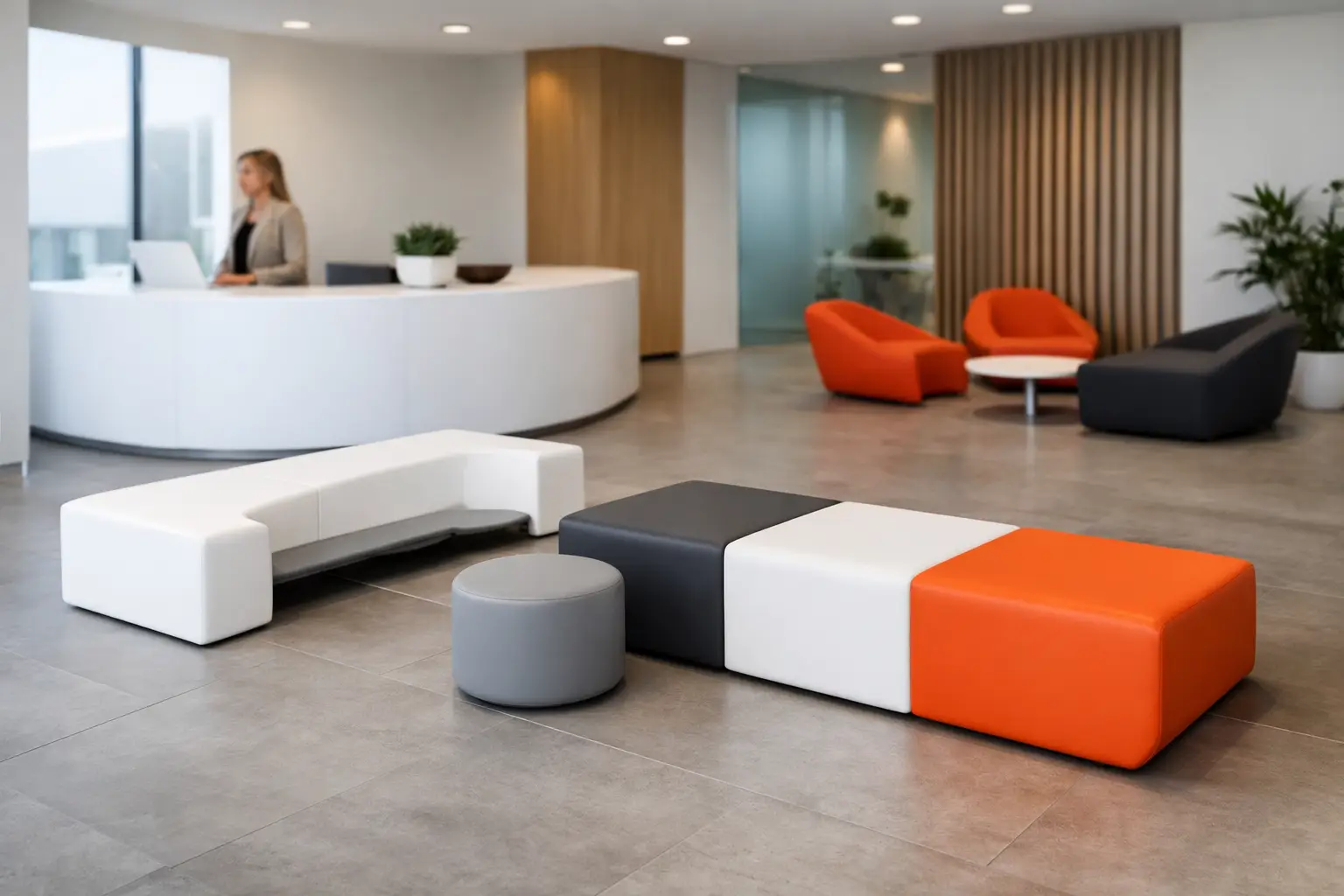
A reception bench sets the tone before anyone reaches the desk. In a hotel lobby, workplace welcome area, gallery entrance, or healthcare waiting zone, it does more than offer a place to sit. It introduces the brand, shapes circulation, and signals whether the space was treated as an afterthought or designed with intent. That is why knowing how to customize reception benches matters early in the project, not after the floor plan is already fixed.
For architects and interior designers, the challenge is rarely finding a bench. It is finding one that fits the geometry, performs in public use, and adds visual character without compromising flow. Customization is where a generic seating element becomes part of the architecture.
How to customize reception benches starts with the room
The strongest reception benches respond to the space before they respond to a furniture catalog. Start by reading the arrival sequence. Where do people enter, pause, queue, turn, and wait? A bench that looks striking in isolation can fail if it blocks sightlines, narrows circulation, or competes with the reception desk instead of supporting it.
This is why shape comes first. In a compact reception area, a clean linear bench may preserve clarity and leave enough negative space around it. In a larger lobby, curved or modular forms can soften the architecture and help organize movement without adding walls or barriers. In branded environments, a sculptural bench can function almost like a low architectural gesture, guiding the visitor while reinforcing identity.
There is always a trade-off here. The more expressive the form, the more carefully it must be integrated into the plan. A dramatic piece can elevate the whole room, but only if access, cleaning, and user comfort remain easy.
Form should follow use, not just aesthetics
Reception seating has a different job than lounge seating. People are often waiting briefly, checking phones, reviewing documents, or preparing for an appointment. They may not want to sink into a deep soft form. They need support, comfort, and a posture that feels natural for short stays.
That affects proportions. Seat height, depth, edge profile, and back support should all be considered in relation to how the bench will actually be used. A backless bench may work beautifully in a retail or gallery setting where waiting is casual and turnover is fast. In a medical, workplace, or hospitality context, adding back support or subtle contouring may improve the experience significantly.
Customization gives you control over that balance. Instead of forcing a standard product into an atypical setting, you can adjust dimensions and geometry to suit the project. That may mean a sharper profile for a fashion-led space, a softer radius for a family-facing environment, or a more generous seat depth in a premium hospitality lobby.
Material and finish determine whether the concept survives contact
The visual language of a reception bench matters, but public-facing furniture has to perform under pressure. Constant use, bags dragged across edges, cleaning cycles, and occasional impact all test whether a design is truly specification-ready.
This is where finish becomes more than a styling choice. Coated foam construction offers unusual freedom because it allows for monolithic shapes, soft edges, and sculptural forms that would be difficult to realize in conventional upholstery or hard-shell fabrication. It also changes how the object behaves in a commercial environment. A continuous coated surface can simplify maintenance, reduce visual clutter, and support a more precise formal expression.
That said, not every project needs the same surface character. Some spaces call for a smooth, crisp finish that feels almost architectural. Others benefit from a softer visual read or the addition of cushions for contrast and comfort. The right specification depends on the traffic level, the cleaning protocol, and the emotional tone of the interior.
When you customize, ask a simple question: should the bench read like furniture, or like part of the built environment? That answer will guide the finish direction quickly.
How to customize reception benches for brand impact
Reception zones carry an outsized branding role. This does not always mean applying logos or obvious graphic statements. Often, the stronger move is to embed the brand into form, color, and attitude.
A bench can echo the curves of a retail concept, pick up an accent color from the identity system, or translate a brand’s personality into something spatial and tactile. In a corporate setting, that might mean disciplined geometry and a restrained palette. In hospitality or experiential retail, it could mean bold silhouettes, saturated color, or modular islands that create a more energetic arrival point.
The key is restraint with purpose. If every custom decision is trying to make a statement, the result can feel forced. Strong reception furniture usually works because one or two design ideas were pushed with conviction. Maybe it is the color. Maybe it is the form. Maybe it is the way the bench integrates with a planter, wall feature, or architectural curve. Precision beats excess.
Modular thinking creates more options
One of the smartest ways to customize reception benches is to think in systems rather than single pieces. Modular benches can adapt to changing traffic, phased projects, and multi-site rollouts while still feeling design-led.
This is especially valuable in large commercial interiors or branded environments that need consistency without repetition. A modular family can be configured as a straight run in one location, an L-shape in another, and a freeform cluster elsewhere. The language stays coherent, but the response becomes site-specific.
For specifiers, this also helps with practical constraints. Modules can simplify transport, installation, and future reconfiguration. If a space is likely to evolve, modularity builds in flexibility from the start.
Of course, modules only work well when the joints, proportions, and transitions have been designed carefully. Poorly resolved modular seating can look temporary. The goal is a system that feels intentional and architectural, not pieced together.
Details make the customization believable
A custom bench is rarely defined by one big move. More often, it is the accumulation of smaller decisions that gives the piece authority.
Edge radii affect whether the object feels sharp, friendly, playful, or refined. Plinth treatment changes how heavy or light it reads. Integrated backs and arms can shift the bench from open and social to more structured and directional. Color blocking can articulate zones or break down scale. Even something as simple as whether the bench sits flush to a wall or floats in the room changes its presence.
These details should always tie back to the project’s broader design language. If the interior architecture is crisp and minimal, overly soft furniture geometry may feel disconnected. If the environment is expressive and fluid, rigid orthogonal benches may flatten the concept.
This is where a capable fabrication partner becomes critical. Creative intent needs to survive technical development. Ambitious forms only work when they are resolved for production, durability, and repeatability.
Specification should happen early
Too many reception benches are customized too late, when the layout is fixed and the furniture is expected to solve leftover problems. That is usually when compromises creep in. Dimensions become awkward, circulation gets pinched, and the bench starts compensating for planning issues it was never meant to fix.
The better approach is to develop the seating in parallel with the reception layout, material palette, and branding strategy. Early coordination allows the bench to do more. It can help define zones, support wayfinding, absorb awkward geometry, or become a visual anchor from the entrance.
It also creates space for technical refinement. You can test proportions, review finish samples, and adjust form before production constraints tighten the options. For design-led commercial spaces, that early collaboration often makes the difference between a custom piece that feels essential and one that feels merely different.
Make it memorable, then make it usable
The best reception benches are remembered for their presence and appreciated for how naturally they work. They do not rely on novelty alone. They earn attention through proportion, material intelligence, and a clear relationship to the architecture around them.
If you are deciding how to customize reception benches, focus on the tension that makes great commercial furniture compelling: expressive enough to shape the space, disciplined enough to serve it. That is where customization stops being decoration and starts becoming design. And when that balance is right, the bench does not just fill a waiting area. It becomes part of the first impression people carry with them long after they leave.