
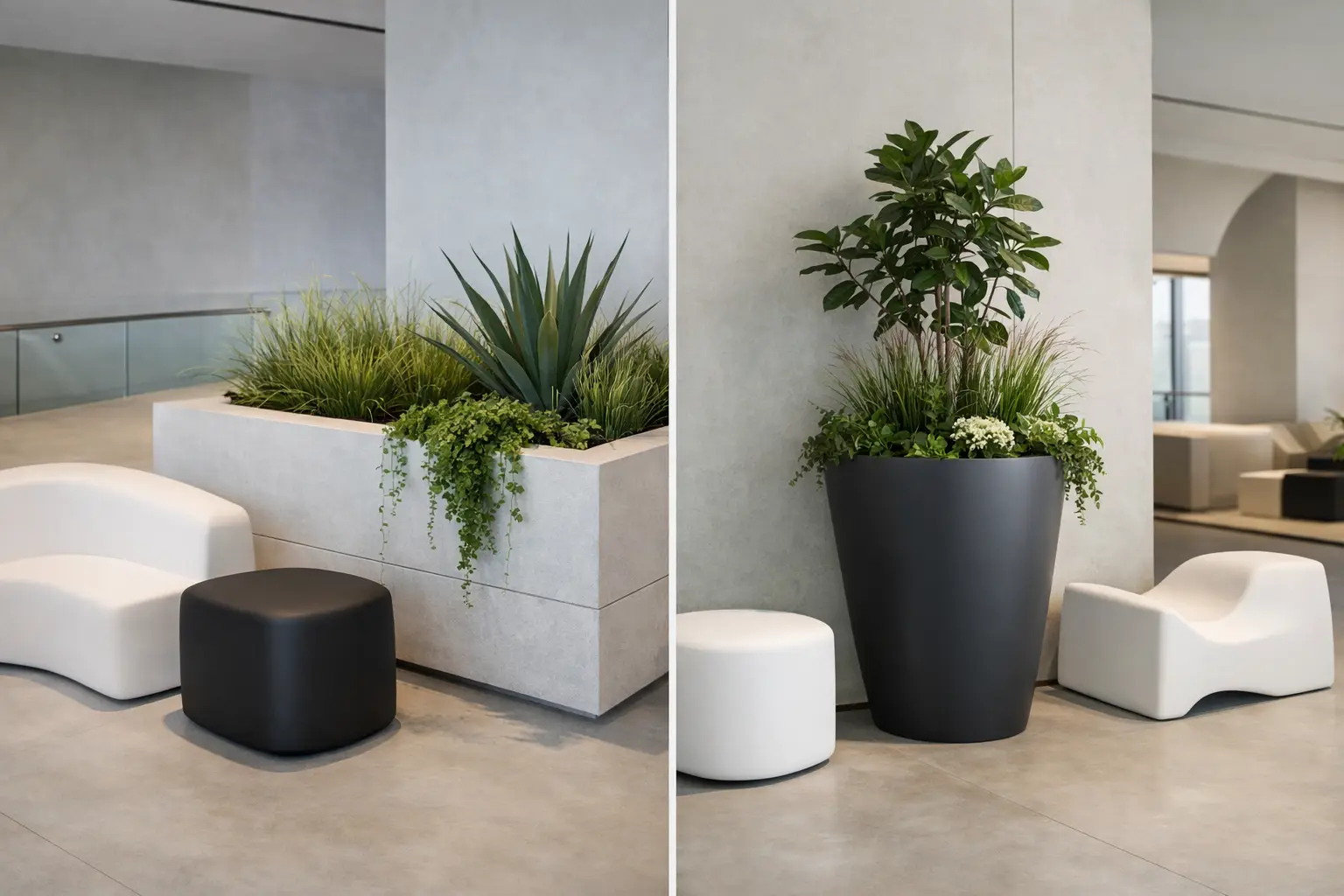
A planter can do much more than hold greenery. In a hospitality terrace, a workplace lobby, or a branded retail interior, it can shape circulation, define thresholds, soften hard surfaces, and carry the visual language of the entire project. That is why the choice between architectural planters vs freestanding planters is rarely just about style. It is a specification decision that affects movement, maintenance, durability, and how the space is ultimately experienced.
For design professionals, the distinction matters because these two planter types solve different problems. One behaves like part of the built environment. The other acts more like a movable furnishing element. Both can be visually powerful, but they perform in different ways once a project moves from concept boards to daily use.
Architectural planters vs freestanding planters: the core difference
Architectural planters are integrated into the spatial concept. They often read as extensions of walls, benches, dividers, façade lines, terraces, or built-in landscape features. Their value comes from their relationship to architecture – proportion, alignment, permanence, and control. In many projects, they are specified to create order and structure as much as to introduce planting.
Freestanding planters, by contrast, are independent objects. They can anchor a corner, punctuate an open floor, break up a large terrace, or add greenery without requiring a built-in intervention. Their strength is flexibility. They can be moved, replaced, regrouped, or rotated as layouts evolve.
That sounds straightforward, but in practice the decision is more nuanced. A freestanding planter can still feel sculptural and highly architectural. An architectural planter can still be fabricated as a distinct object rather than poured into the building fabric. The real question is not which category sounds more elevated. It is which one serves the intent of the space.
When architectural planters make more sense
Architectural planters are strongest when planting needs to participate in the geometry of the project. If the design relies on long sightlines, repeated forms, integrated seating, or clearly framed zones, this approach usually offers more control.
In commercial environments, that control has practical value. A planter that defines a circulation path or separates a lounge from a passage route should not drift over time. In a rooftop setting, a perimeter planter may also function as an edge condition, a wind buffer, or part of a larger outdoor composition. In public and hospitality spaces, permanence often supports the clarity that designers work hard to build into a plan.
This type also excels when the planter is doing double duty. It may combine with seating, create privacy, organize waiting zones, or support a branded architectural language through shape, finish, and color. For projects with a strong formal concept, integrated planters often produce a cleaner result because they avoid the visual afterthought effect that loose accessories can create.
There is, however, a trade-off. Architectural planters usually require earlier coordination with architecture, landscape, and operations teams. Drainage, irrigation, weight, cleaning access, and planting maintenance need to be resolved before installation. Once they are in place, change becomes more difficult. That can be a strength in a fixed concept, but it is less ideal in spaces that will be reprogrammed frequently.
Best-fit applications for architectural planters
They tend to be the right move in hospitality terraces, corporate campuses, airports, public plazas, and large interior environments where the planter is part of the spatial framework. They also suit branded environments where every element needs to reinforce a distinct visual identity rather than look selected from a generic accessory catalog.
Where freestanding planters outperform
Freestanding planters answer a different set of project pressures. They are ideal when flexibility matters, when installation needs to be simpler, or when the design team wants to test and evolve the arrangement over time.
In retail, coworking, event, and mixed-use environments, layouts often shift. Tenant needs change. Seasonal programming changes. Furniture groupings change. A freestanding planter supports that reality without forcing a redesign. It can be used as a soft divider one season, a focal point the next, and relocated entirely when circulation patterns prove different from what the original plan predicted.
They are also useful when the architecture itself is intentionally neutral and the design language is carried by objects within the space. In these cases, the planter can behave like sculptural furniture – bold, graphic, and expressive without requiring construction integration.
From a project management perspective, freestanding planters are often easier to specify and implement. They typically involve less site coordination and can be introduced later in the project timeline. That makes them attractive when budgets tighten or when teams want visual impact without reopening architectural details.
The limitation is equally clear. Because they are movable, they can lose alignment, especially in high-traffic or publicly accessible areas. They may also feel less resolved if the project depends on a highly integrated architectural expression. A beautiful planter object does not automatically create architectural order.
Form, scale, and visual authority
The debate around architectural planters vs freestanding planters often gets reduced to permanence versus mobility, but form and scale are just as important. A planter’s visual authority depends on how it occupies space.
Architectural planters typically work at larger scales and with stronger horizontal or linear gestures. They can stretch across a façade, frame a lounge, or carve out an exterior room. That larger reading gives them the power to organize space rather than simply decorate it.
Freestanding planters usually operate more like punctuation. They can still be oversized and dramatic, but they are read as discrete volumes. That distinction matters in open commercial environments. If the intention is to create a room-like condition, a series of independent planters may not deliver the same coherence as a purpose-designed architectural element.
That said, custom fabrication changes the conversation. When a freestanding planter is developed with the same formal discipline as a built-in element, it can carry architectural presence without sacrificing adaptability. This is where material expertise and manufacturing capability matter. Unconventional forms, monolithic volumes, curved geometries, and project-specific finishes can elevate a movable planter into something far more intentional.
Specification factors that decide the winner
For architects and specifiers, the real choice is usually made by performance criteria. Weight, substrate volume, drainage strategy, indoor or outdoor exposure, cleaning requirements, and resistance to impact all affect which direction makes sense.
Architectural planters tend to be selected when consistency and long-term placement are essential. They are often better for projects where planting size is substantial, where integrated irrigation is required, or where the planter needs to align exactly with other built elements.
Freestanding planters tend to be favored when the team needs simpler installation, less disruption on site, or the freedom to revise layouts. They can also be the smarter solution for leased spaces or phased rollouts where permanence is not yet justified.
Material selection is central in both cases. A planter in a hotel courtyard, airport concourse, or education setting needs more than a clean silhouette. It needs to withstand repeated contact, maintenance cycles, and the realities of commercial use. Finish quality, fabrication precision, and weather resistance all shape whether the object still looks intentional after years of service.
Customization changes both categories
This is where many projects open up. The old assumption is that architectural planters are custom and freestanding planters are off-the-shelf. That distinction no longer holds. A freestanding planter can be fully customized in scale, profile, radius, finish, and color to align with a project’s spatial language. Likewise, an architectural planter can be fabricated as a production-ready object with precise repeatability rather than treated as a one-off site-built solution.
For design-led spaces, that flexibility is powerful. It allows planting elements to work as part of a larger sculptural system, coordinated with seating, dividers, or public-space furniture. Brands like Sixinch operate especially well in this territory because fabrication is not limited to standard geometries or commodity finishes. The planter becomes part of the design vocabulary, not a late-stage accessory.
So which should you specify?
If the planter needs to shape the architecture, stabilize circulation, or become part of a permanent spatial framework, architectural planters are usually the stronger choice. If the project needs adaptability, phased implementation, or object-based visual impact, freestanding planters often offer more value.
The smartest projects do not treat this as a binary decision. They use each type where it performs best. A rooftop may rely on architectural planters at the perimeter and freestanding sculptural planters within lounge zones. A workplace can use integrated planters to define team neighborhoods and movable ones to support seasonal reconfiguration. Good specification comes from understanding what the planter is being asked to do.
The best planter is not the one that looks most architectural on a mood board. It is the one that holds its form, supports the planting strategy, and makes the space feel more resolved every day it is used.