
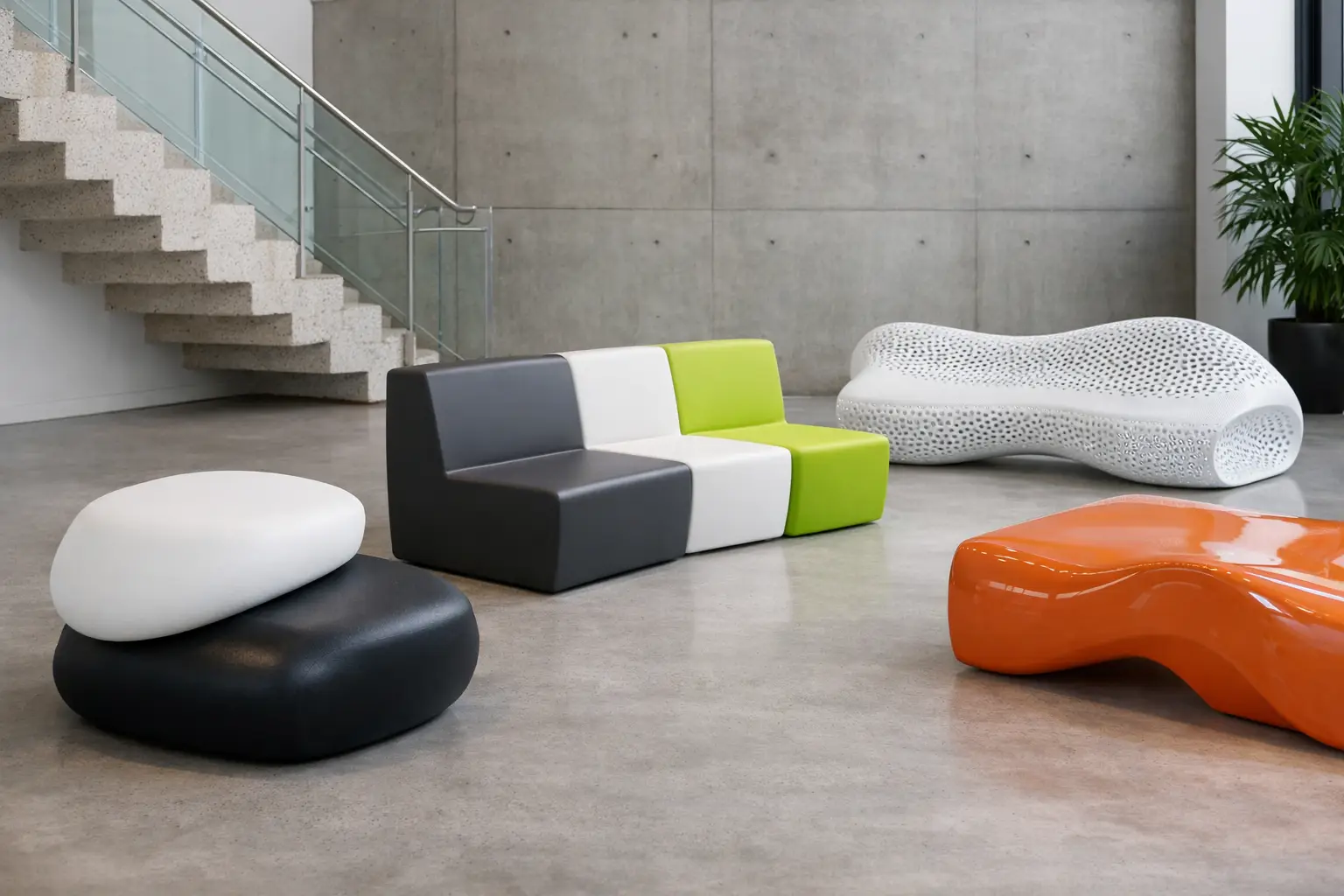
A lobby bench can look immaculate on opening day and exhausted six months later. The difference is rarely the silhouette alone. It is the material decision beneath the specification: how a surface reacts to constant contact, cleaning chemicals, UV exposure, spills, impact, and the particular behavior of the people using it. This public seating materials comparison guide is built for designers and specifiers who need seating to remain visually convincing after the project photography is over.
The right choice depends on more than a durability rating. Public seating has to support a design language, meet maintenance realities, fit a budget, and perform in a specific setting. A sculptural lounge seat in a hotel atrium faces different pressures than a modular bench in an airport, a planter-seat on a terrace, or a banquette in a high-traffic retail environment.
Start with the space, not the sample
Material boards are useful, but they can conceal the real conditions of use. Before selecting upholstery, wood, metal, plastic, or coated foam, define the environment in practical terms. Is the seating indoors, outdoors, or in a threshold space with changing temperatures and sunlight? Will users sit briefly, wait for hours, eat and drink, arrive wet from rain, or move luggage across the surface?
Cleaning protocols deserve the same attention as aesthetics. A material that performs well with occasional wiping may be a poor fit for a venue using disinfectants several times a day. Likewise, a refined surface with visible seams or joints can create maintenance points in a setting where crumbs, dust, and moisture accumulate quickly.
Public projects also ask a visual question: should the furniture recede into the architecture, or act as a defining spatial gesture? Conventional materials can be ideal when restraint is the brief. When seating must carry a bold color field, a soft organic volume, a branded form, or a continuous landscape-like composition, fabrication flexibility becomes a central performance criterion.
Public seating materials comparison guide: the major options
Upholstered textiles and vinyl
Textile upholstery brings warmth, acoustic softness, and a broad range of colors and textures. It remains a strong choice for hospitality lounges, workplace settings, libraries, and other interiors where dwell time and comfort matter. Performance textiles can offer stain resistance and abrasion resistance, but no woven surface is entirely maintenance-free. Dirt settles into texture, and repeated cleaning can gradually alter the hand or appearance of the fabric.
Vinyl and coated upholstery are easier to wipe down and are often selected for healthcare, food-service, and high-turnover public interiors. They provide a controlled, tailored look, but the material still depends on stitching, tailoring, foam interiors, and edge details. Over time, seams, tension points, punctures, and delamination can become visible concerns. They are best specified with a clear understanding of expected cleaning frequency and replacement cycles.
Wood and wood veneer
Wood gives public seating a familiar, tactile quality that suits civic interiors, cultural spaces, hospitality, and biophilic design schemes. Solid wood can be refinished and repaired, which gives it a long service life when the construction is sound. Veneer adds consistency and can make larger installations more economical, although edge damage and moisture exposure require careful detailing.
The trade-off is rigidity. Wood is excellent for frames, slatted benches, and architectural seating, but it does not naturally create the cushioned comfort expected in lounge environments. It also expands and contracts with environmental change. In busy settings, corners and leading edges need protection from bags, carts, and repeated impact.
Metal
Steel, aluminum, and stainless steel deliver structural clarity and a lean visual profile. Metal is particularly useful for transit, exterior public areas, and applications that need high load capacity, anchoring, or a deliberately industrial character. Powder coating extends color possibilities and helps protect the surface, while stainless steel performs well in wet or demanding environments.
Metal seating can feel cold, hard, and acoustically active. It is usually strongest as a structural material or as part of a mixed-material assembly rather than as the full answer for long-stay comfort. Outdoor specifications require attention to coating quality, drainage, corrosion risk, and heat gain in direct sun. Dark metal can become uncomfortable quickly on an exposed terrace.
Molded plastic and composite materials
Molded plastic seating is efficient, stackable, and familiar in education, food service, and event environments. It can handle moisture, offers consistent production quality, and supports clean, graphic color. Certain engineered composites add strength, weather resistance, or recycled content.
Its limitations are usually sensory and expressive. Plastic can scratch, fade, or become brittle depending on the formulation and exposure. It also tends to communicate a more standardized product language. For projects where seating is intended to become an immersive element of the interior or landscape, the available geometries may feel restrictive.
Coated foam
Coated foam occupies a different position in the material palette. It combines the soft, body-friendly behavior of foam with a continuous protective coating that can be shaped around highly individual forms. Instead of treating comfort and sculptural presence as separate decisions, it allows them to be developed together.
For public interiors, the absence of conventional upholstery seams is a practical advantage. A continuous coated surface is easy to wipe, visually calm, and well suited to forms that would be difficult to tailor in fabric or build economically in hard materials. Rounded edges, oversized volumes, integrated backrests, playful geometries, and monolithic seating islands become achievable without losing a finished, durable surface.
Performance still depends on specifying the correct coating system and locating the piece appropriately. Interior and exterior conditions are not interchangeable. Direct sun, standing water, sharp objects, and aggressive cleaners should all be considered at the design stage. Coated foam is not a substitute for structural metal where major spans or anchoring loads govern, but it can transform the visible and tactile seating volume around a supporting structure.
Durability is more than hardness
A hard surface is not automatically the most durable one. In public seating, durability means retaining function and visual integrity under the actual stresses of a project. A rigid material may resist compression yet show scratches, dents, or chipped edges. A softer material may absorb impact comfortably but require a surface engineered to resist abrasion and staining.
Assess durability through several lenses: abrasion from clothing and bags, impact from carts and equipment, resistance to moisture and chemicals, UV stability, repairability, and the likelihood of visible aging. The last point is often overlooked. Some materials develop a patina that improves their character. Others simply look damaged. Align that aging behavior with the project concept before committing.
For heavily used interiors, also consider how a piece fails. Can a damaged element be repaired in place? Can a modular section be replaced without disturbing the full installation? Does the construction expose vulnerable edges or hardware? These questions often matter more to facilities teams than a headline warranty figure.
Comfort, cleaning, and form must work together
Comfort is shaped by temperature, edge softness, back support, seat height, depth, and the freedom to change posture. A beautiful bench that forces every user into the same rigid position may suit a brief waiting zone, but it will not perform in a lounge or social setting. The material affects this directly: padded and foam-based surfaces welcome longer use, while wood and metal benefit from ergonomic shaping or integrated cushions.
Cleaning requirements can reshape the design. Deep tufting, open joints, and complex stitched upholstery create visual richness but also catch debris. In food-service areas, family-focused venues, transport hubs, and public waiting spaces, continuous surfaces often reduce daily labor and help the furniture remain intentional rather than merely serviceable.
Form should not be treated as decoration added after the technical choice. It can improve circulation, create informal boundaries, support different group sizes, and turn a large open room into a sequence of usable zones. This is where custom fabrication has genuine strategic value. A seating element can follow an architectural curve, echo a brand mark, integrate planting, or create a focal point that standard modules cannot provide.
Specify for the lifecycle you actually expect
The lowest initial cost is rarely the lowest project cost. Public seating should be evaluated against expected occupancy, cleaning labor, repairs, disruption during replacement, and the visual cost of premature wear. A high-traffic venue may benefit from a material with a higher initial investment if it stays cleaner, requires fewer interventions, and preserves the intended guest experience for longer.
Ask manufacturers for material-specific maintenance guidance rather than assuming all surfaces tolerate the same products. Request samples, but test them realistically: wipe them, expose them to the cleaners used on site, place them in the proposed lighting, and assess their feel at body temperature. For custom forms, review drawings and prototypes early enough to refine seams, drainage, support, and transitions before production.
Sixinch approaches this decision as both a material and fabrication question. The goal is not simply to cover a seat, but to produce a form whose surface, comfort, color, and construction are designed to perform as one object.
The most successful public seating does not ask people to notice its material first. It gives them an immediate sense that the space was designed for real use, then continues to prove that decision through every busy day that follows.