
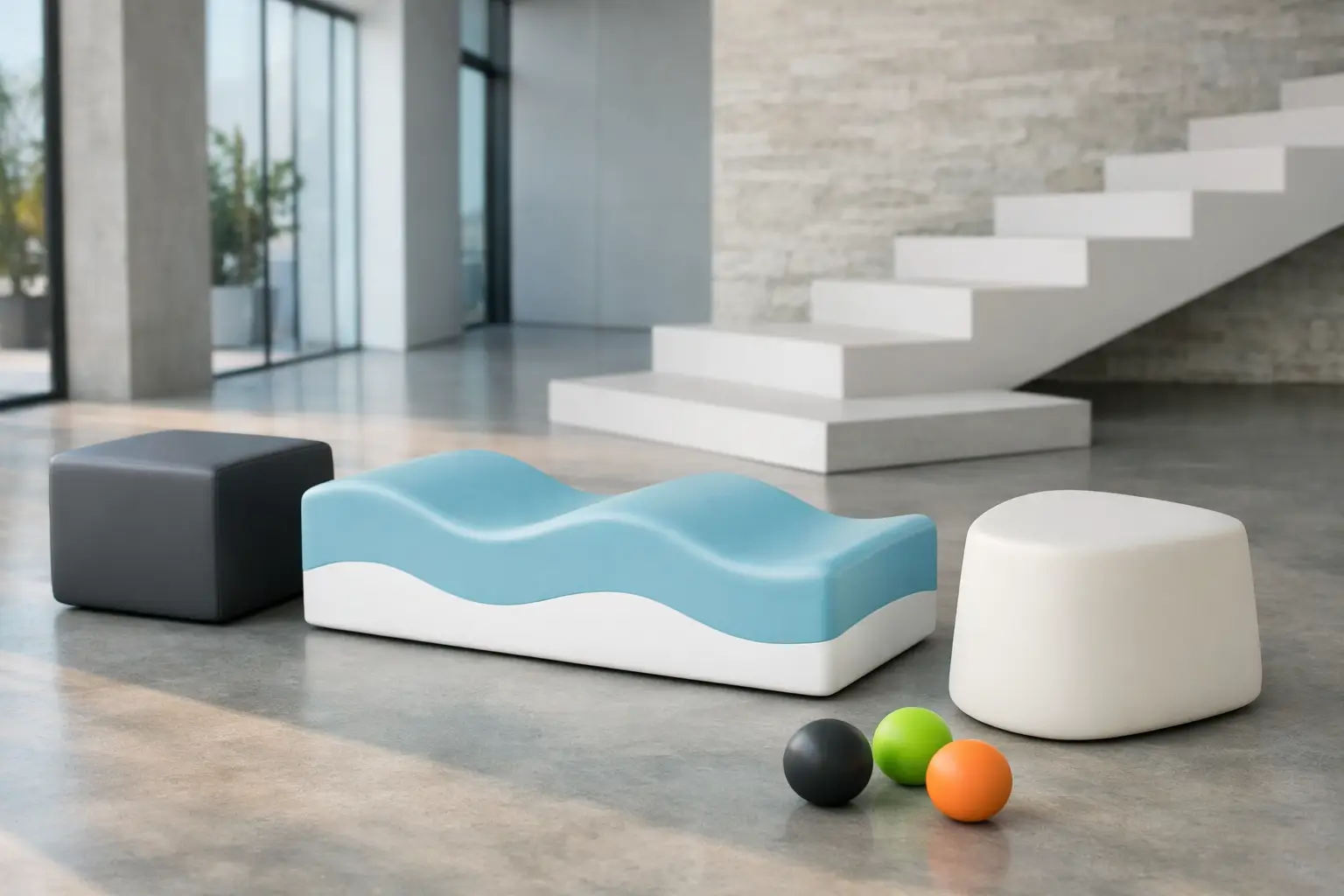
A sculptural bench can look perfect in a rendering and still fail on the floor if the finish is wrong. When architects and designers ask how to choose coated foam finishes, they are rarely choosing color alone. They are deciding how a piece will read in space, how it will perform under traffic, and how confidently it can support an original concept over time.
Coated foam opens up forms that rigid materials often resist – rounded volumes, soft monoliths, playful geometry, and custom pieces that feel almost impossible until they are built. But that design freedom only works when the finish is specified with the same discipline as the form itself. The right finish sharpens the concept. The wrong one can flatten it, overexpose wear, or create unnecessary maintenance issues.
How to choose coated foam finishes for the real setting
The first filter is always the environment. A finish for a hotel lounge, a university commons, and an outdoor terrace may share the same visual language, but they should not be approached as interchangeable.
In a low-contact setting, the finish can lean more expressive. You may prioritize a very specific tactile quality or a cleaner, more minimal surface appearance because the piece is not expected to absorb constant abrasion. In a high-traffic public zone, the calculation changes. Here, resistance to repeated contact, ease of cleaning, and visual consistency after heavy use matter just as much as the initial design statement.
This is where coated foam becomes especially valuable. It allows designers to preserve bold geometry without adding seams, loose upholstery, or material transitions that complicate maintenance. Still, there is no universal best finish. There is only the finish that matches the intensity and behavior of the space.
If people will sit on it with bags, drag against it with denim, spill on it, or use it as an informal perch rather than a conventional seat, specify for that reality early. A finish that looks refined in a presentation sample may not be the right answer for a lobby that operates almost like a transit zone.
Start with the visual effect, not just the sample chip
Many finish decisions go off track because the evaluation happens too close-up. A small sample is useful, but coated foam is experienced at object scale. Curves, edges, light reflection, and shadow all change once the finish is applied to a larger volume.
If the piece is meant to read as architectural, the finish should support that intention. Smooth, continuous surfaces can make a bench or planter feel carved and monolithic. More textured finishes can soften that effect and make a large form feel more approachable or casual. Neither is automatically better. It depends on whether the object should disappear into the space, punctuate it, or act almost like a branded sculpture.
Color interacts with finish in the same way. A saturated tone on a smooth surface can feel crisp, graphic, and highly controlled. The same color on a more textured finish can feel warmer and less severe. Dark colors often emphasize shape and silhouette, while lighter tones reveal more of the surface character and are less forgiving of dirt in some settings. Bright colors can be powerful, but they place more pressure on consistency, cleaning, and long-term visual upkeep.
For design-led interiors, this is the useful question: what should visitors notice first – the form, the color, or the surface? The finish should help answer that.
Texture changes perception and use
Texture is not an afterthought. It changes both the look and the social behavior of a piece.
A smoother coated foam finish usually reads more precise and more architectural. It suits spaces where you want strong visual impact and a refined object quality. It is often a smart fit for branded interiors, gallery-like hospitality spaces, and projects where the furniture needs to support a clean, intentional material palette.
A more tactile surface can make a piece feel less formal and more inviting. In collaborative spaces, family-oriented hospitality, or playful public settings, that softer visual read can be an advantage. It can also help conceal minor signs of use better than very sleek finishes.
The trade-off is simple. The more exacting the visual language, the more disciplined the maintenance and usage expectations may need to be.
Think about contact patterns, not just durability claims
Durability is often discussed too broadly. A finish is not simply durable or not durable. It performs differently depending on how people interact with the object.
Consider where contact happens most. Is the piece primarily sat on, leaned against, climbed over, or used as an informal table edge? A sculptural seat in retail may experience constant side contact from shoppers passing by. A hospitality banquette may see repeated pressure concentrated in the same zones. A public-space element might be exposed to shoes, bags, weather shifts, and irregular cleaning routines.
These patterns influence what kind of coated foam finish makes sense. Some projects benefit from a finish selected primarily for easy maintenance. Others need one that preserves a sharper visual expression under repetitive use. For outdoor or semi-outdoor applications, exposure adds another layer – UV, moisture, temperature variation, and dirt all affect the specification conversation.
Designers who get the best results do not ask only how strong the finish is. They ask how the object will actually be used when no one is supervising it.
Indoor and outdoor are different design problems
A coated foam piece that works beautifully indoors will not automatically translate outdoors. Exterior applications require a finish that can hold visual and functional integrity through changing conditions, not just occasional exposure.
That affects more than weather resistance. Outdoor pieces are often seen from a distance and used more casually. Their finish has to perform under sun, rain, temperature swings, and public interaction while still delivering a clear design statement. Texture, color depth, and surface appearance all behave differently outside, where natural light is harsher and wear is less controlled.
For landscape and terrace projects, it helps to treat finish selection as part of the architectural envelope, not simply as furniture styling.
Match the finish to the project lifespan
Some installations are expected to look pristine for years. Others are campaign-driven, seasonal, or tied to shorter brand activations. That distinction matters.
If the project has a long lifecycle, choose a finish that will age with dignity. That usually means balancing aesthetic ambition with practical resilience. Extremely light colors, highly revealing surfaces, or very precious-looking specifications can be right, but only when the client understands what upkeep will demand.
For temporary or event-based concepts, you may have more freedom to prioritize drama over long-term neutrality. This is often where coated foam excels – it can deliver unusual forms and immersive visual impact without forcing the design into standard construction logic. But even short-term installations should be specified intelligently if they are public-facing or repeatedly handled.
The most successful finish choices are rarely the most cautious or the most flamboyant. They are the ones aligned with the actual life of the project.
How to choose coated foam finishes with custom pieces
Custom work introduces a different level of responsibility. When the form is unique, the finish is doing more than protecting a surface. It is helping define the identity of the object itself.
Complex curves, oversized volumes, integrated branding, and unusual proportions all place extra pressure on finish selection. A finish that looks excellent on a standard pouf may behave differently on a long serpentine bench or a faceted reception element. Scale changes perception. So does geometry.
This is why mockups and material dialogue matter. For bespoke pieces, the smartest path is to evaluate finish in relation to the exact shape, the intended lighting, and the expected viewing distance. A finish should never be selected in isolation from form. On ambitious projects, that separation usually leads to surprises too late in the process.
At this stage, a fabrication partner’s expertise becomes part of the design value. Sixinch, for example, works in the space where concept and coated-foam execution have to meet without compromise. That matters when the goal is not just to produce furniture, but to preserve the edge of the original idea.
Ask better specification questions
If you want a finish decision to hold up, ask sharper questions early. What kind of wear will be visible first? What cleaning routine is realistic for the client? Will the piece be photographed constantly? Is the design meant to feel playful, premium, quiet, or confrontational? Should the surface disappear, or should it announce itself?
Those questions often reveal conflicts before production starts. A client may want a pale, minimal finish in a heavily used public setting with limited maintenance support. That is possible, but it is not neutral. It comes with consequences. Likewise, a highly textured or visually active finish may hide wear better, but it may also soften an architectural concept that depends on precision.
The point is not to avoid risk. It is to choose the right one.
Coated foam finishes work best when they are treated as part of the design language, not as a final cosmetic layer. When finish, form, and use are aligned, the result feels inevitable – bold in appearance, clear in purpose, and ready to perform where people actually encounter it.
1 comment